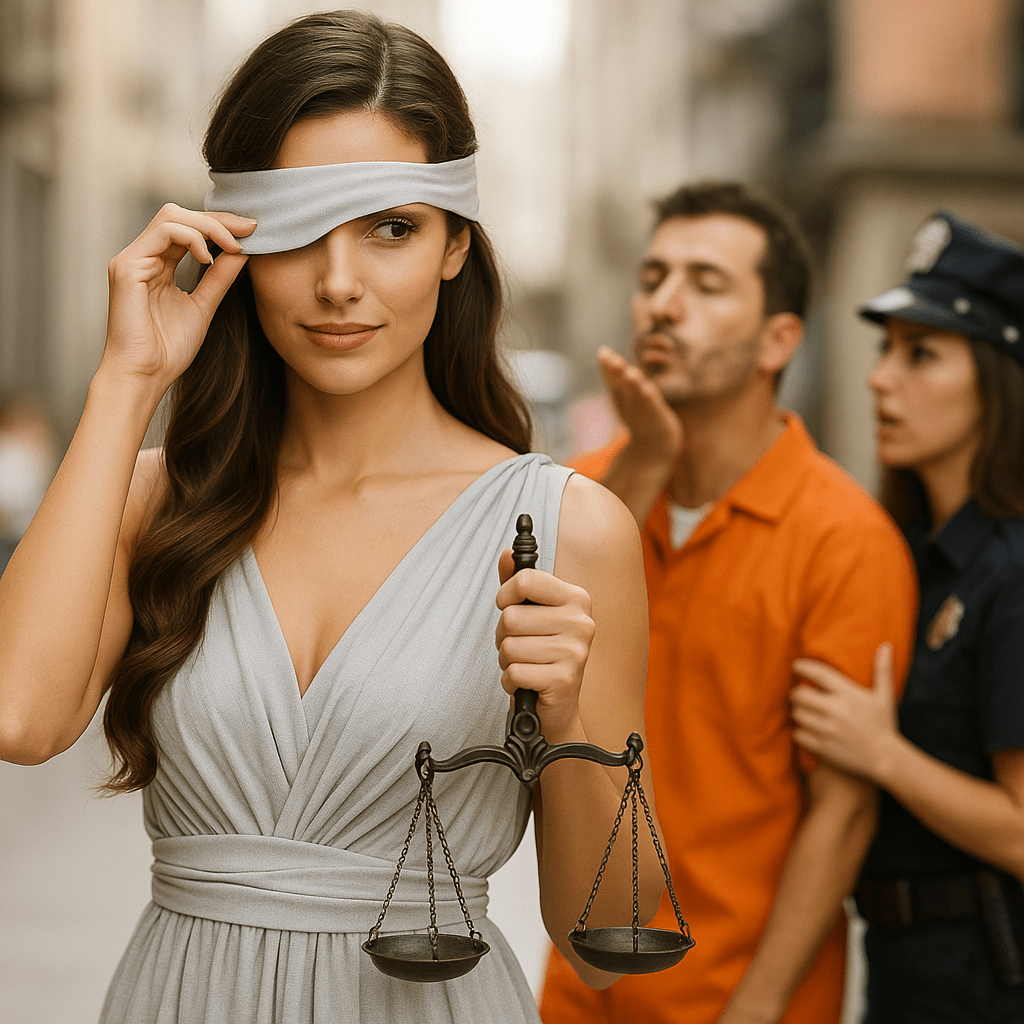
Blind by Choice
Black Powder Podcast Journal • Easy read, strong read • By the Black 2A lens—without shutting anyone out.
Why this case hit different
When violence happens in America, the courtroom is supposed to judge the facts—yet the public often runs a second trial: a moral trial.
And that moral trial doesn’t just ask “what happened?” It asks “did we like the reason?” and sometimes even “did we like the person?”
That’s what makes the Luigi Mangione case such a cultural flashpoint. He’s accused of killing UnitedHealthcare CEO Brian Thompson in Manhattan on Dec. 4, 2024.
Mangione was arrested days later in Pennsylvania after a report that he matched the circulated image of the suspect; prosecutors say police recovered a gun-related magazine, a firearm and other items, plus writings they argue point to motive and planning. Mangione has pleaded not guilty, and his defense is challenging searches and evidence in pretrial hearings.
AP report,
People summary
Quick timeline
- Dec. 4, 2024: Brian Thompson is shot and killed in Manhattan. Source
- Dec. 9, 2024: Mangione is arrested in Altoona, PA; evidence recovery becomes a major legal fight. Source
- 2025: Suppression hearings and arguments over what evidence can be used continue. ABC News
Demonization vs. sainthood: how the “moral meter” moves
Here’s the uncomfortable truth: the same act can get two different moral reactions depending on what the crowd believes the act represents.
Some people hear “CEO killing” and immediately file it under pure evil. Others hear “healthcare industry” and start drifting into grievance fantasy—like motive can convert murder into meaning.
As a 40-year-old Black 2A voice, I’m saying this plainly: motive explains—it does not excuse. And our society is playing with fire when we treat violence like a political love language.
How this affects modern society
- We normalize “narrative justice”—where your story matters more than your actions.
- We reward performative outrage—the loudest take wins, not the most accurate one.
- We train people to pick sides before facts—which makes due process harder and healing slower.
How this affects 2A society
- Every high-profile shooting becomes a proxy war over gun rights—even when the real issue is radicalization, grievance, or broken institutions.
- Bad actors get used as props—either to argue “guns are the problem” or to argue “nothing is the problem.” Neither helps.
How this affects Black 2A society
- Double standards get louder: who gets called “a threat,” who gets called “a hero,” and who never gets the benefit of the doubt.
- Self-defense conversations get contaminated: When the public confuses vigilantism with protection, Black gun owners feel the backlash first.
- Trust erodes: Unequal outcomes and selective empathy poison unity—inside and outside the 2A space.
Comparison snapshot: who gets sympathy, who gets scrutiny?
This isn’t about declaring guilt online. It’s about recognizing the pattern: narrative often outruns law.
| Case | Public flashpoint | What people argued | What it reveals |
|---|---|---|---|
| Luigi Mangione | CEO killing + alleged writings + evidence fight | “Monster” vs. “anti-corporate symbol” | We treat motive like a moral coupon. AP |
| Daniel Penny | Subway chokehold death of Jordan Neely | “Protector” vs. “excessive force” | Public safety fears collide with racial and class realities. Reuters, PBS |
| Roger Fortson | Airman killed in his own home during law enforcement response | “Split-second decision” vs. “unjustified shooting” | Gun-in-home meets authority-in-uniform—and the margin for error turns deadly. NPR/WAMC, 6ABC |
| Atlanta “Porch Package” Shooting | Homeowner accused of shooting teens allegedly stealing packages | “Defending property” vs. “overreaction” | We’re drifting toward “property rage” becoming socially excusable violence. 11Alive, WSB-TV |
Global contrast: Shinzo Abe proves a hard lesson
Some people talk like tighter gun laws alone erase violence. Japan is often cited because civilian gun ownership is heavily restricted.
Yet in 2022, former Japanese Prime Minister Shinzo Abe was assassinated with a homemade gun.
Reuters reported analysts saying the improvised firearm could be made quickly using accessible materials—showing that bad motives will find a way, even where legal access is nearly nonexistent.
Reuters
That doesn’t mean “laws don’t matter.” It means we can’t ignore the deeper problem: radicalization + grievance + cultural permission.
When society starts rewarding “the right kind of violence,” you don’t get less violence—you get copycats chasing applause.
What could we learn as a society?
- Stop grading violence on a curve. If the act is wrong, the motive doesn’t magically make it right.
- Protect due process for everyone. A fair system means the same rules apply, even when feelings are high. Related coverage
- Learn the difference between self-defense and social revenge. Especially inside gun culture, we have to keep that line sharp.
- Build a culture of restraint. A mature society doesn’t romanticize violence; it solves problems without blood.
- Be honest about unequal empathy. Who gets sympathy often depends on race, class, politics—and sometimes aesthetics. That’s not justice. That’s bias in designer clothes.
Sources
- Mangione evidence + arrest details (AP): apnews.com
- Mangione suppression hearing coverage (ABC): abcnews.go.com
- Daniel Penny verdict (Reuters): reuters.com
- Daniel Penny case explainer (PBS): pbs.org
- Roger Fortson deputy charged (NPR/WAMC): wamc.org
- Roger Fortson case court update (6ABC): 6abc.com
- Atlanta porch-package shooting (11Alive): 11alive.com
- Atlanta porch-package shooting (WSB-TV): wsbtv.com
- Shinzo Abe assassination DIY gun analysis (Reuters): reuters.com
In America, the Second Amendment is universal—but forgiveness is not.
“`0

Leave a comment